WoW guild ranks: a rank structure template that works
A WoW guild rank structure you can copy: 8 ranks with what each can do, alternative rank names by theme, and how ranks map to Discord and GuildPro roles.
In this post
A good WoW guild rank structure has 6 to 8 ranks: guild master, officer and raid lead at the top with permissions over other members, then core raider, raider, member, trial and alt. Each rank should have a one-line reason to exist. Copy the ladder below, pick a name set that fits your guild, and use the same names in game, in Discord and on your guild page.
Ranks are the guild’s org chart, and in a new WoW Forever guild they get set in a hurry on launch night. That’s fine for a week. By the time raids open on 9 December, the ranks decide who can invite, who gets first call on raid spots, and who people ask when something goes wrong. This page gives you a ladder to copy, name sets to choose from, and a way to keep game, Discord and guild page in step.
What ranks should a WoW guild have?
Separate the ranks that act on other members from the ranks that describe members. The top 2 or 3 ranks carry permissions. The rest describe someone’s standing: raiding, social, on trial or an alt.
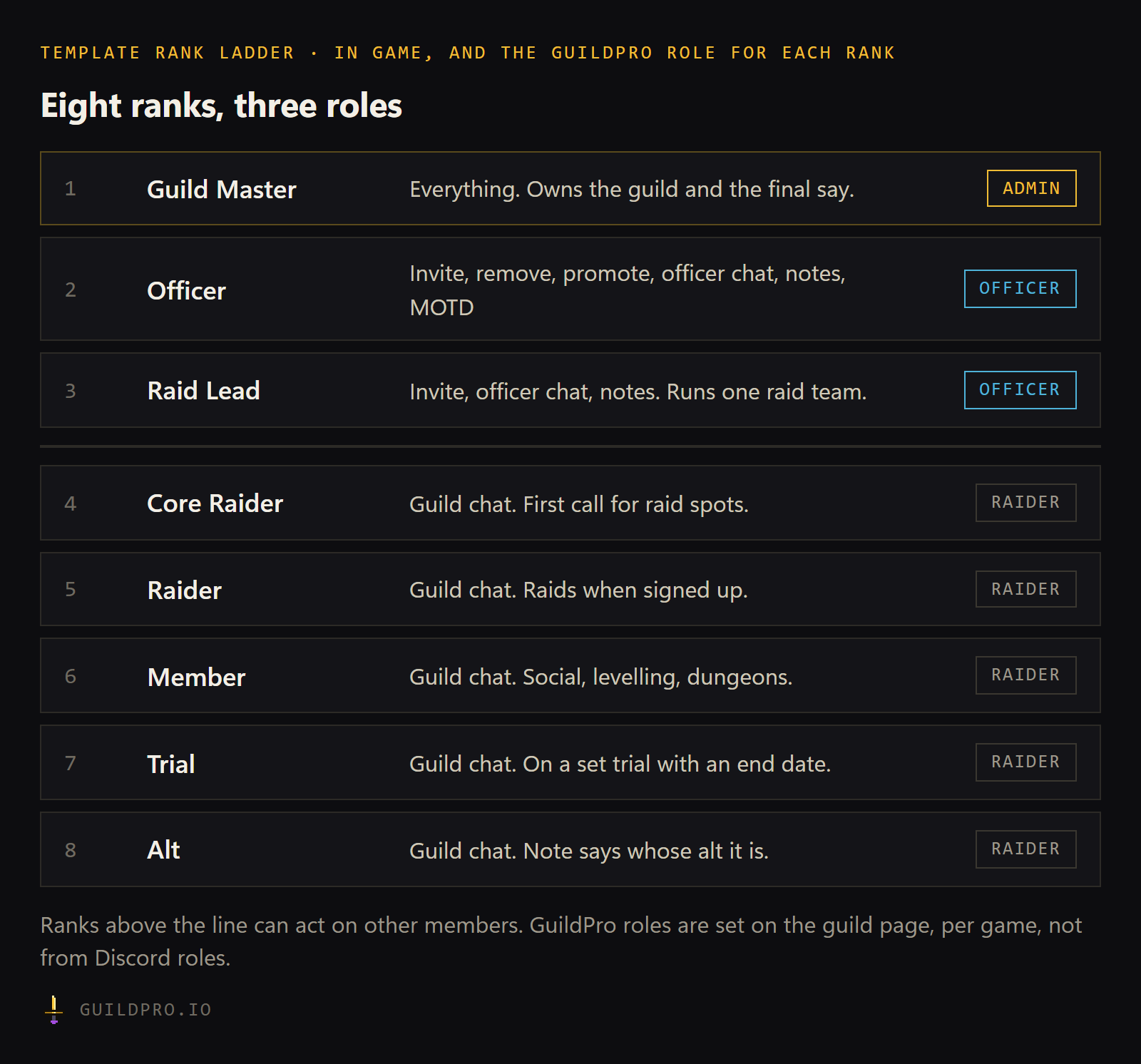
Why these eight:
- Guild Master. One person. Has every permission and the final say.
- Officer. Runs the guild with the guild master. Invites, removes and promotes.
- Raid Lead. Runs a raid team. Needs to invite and read officer chat, but not to remove members. This rank matters more in Forever, where 10, 20 and 40-player raids all open on 9 December (per Wowhead’s raid overview), and a bigger guild may run a team for each.
- Core Raider. Proven, reliable raiders. First call for raid spots.
- Raider. Raids when signed up. Most of a raiding guild sits here.
- Member. Social, levelling and dungeon players, and anyone who doesn’t raid.
- Trial. New recruits on a trial with an end date.
- Alt. Every alt, with the main’s name in the public note.
A social guild can drop Core Raider and Raider and still have a clear ladder. A guild with two raid teams can rename Raid Lead to “Raid Lead · Team A” and “Raid Lead · Team B”, but keep it as one rank if you can.
What should each rank be allowed to do in game?
Give each rank the permissions its job needs, and nothing more. WoW’s guild control panel has long offered settings such as guild and officer chat, inviting, removing, promoting, demoting, editing notes and setting the message of the day. Check the panel in Forever for the exact list before you set it, since this page can’t promise every option is the same.
| Rank | Guild chat | Officer chat | Invite | Remove | Promote / demote | Notes and MOTD |
|---|---|---|---|---|---|---|
| Guild Master | Yes | Yes | Yes | Yes | Yes | Yes |
| Officer | Yes | Yes | Yes | Yes | Yes, below Officer | Yes |
| Raid Lead | Yes | Yes | Yes | No | No | Edit notes |
| Core Raider | Yes | No | No | No | No | No |
| Raider | Yes | No | No | No | No | No |
| Member | Yes | No | No | No | No | No |
| Trial | Yes | No | No | No | No | No |
| Alt | Yes | No | No | No | No | No |
Two rules keep this safe:
- Only trusted people can remove members. A removal by mistake on raid night is a mess to undo.
- Write down why each person has their rank. A short officer note (“Core: 8 of last 10 raids”) ends most “why aren’t I core?” conversations before they start.
What can I call the ranks?
Plain names work for every guild. Themed names are fine if a new member can still tell the order. Pick a set below. Each is a full ladder from top to bottom, ready to type into the guild control panel.
Plain
The safest choice. Nobody has to ask what a rank means.
1. Guild Master
2. Officer
3. Raid Lead
4. Core Raider
5. Raider
6. Member
7. Trial
8. Alt
Military
Suits a raiding or PvP guild that likes a bit of order.
1. Commander
2. Captain
3. Lieutenant
4. Sergeant
5. Soldier
6. Recruit
7. Cadet
8. Reserve
Roleplay
Sounds like an organisation in the world. Fits the Roleplay and Roleplay-PvP rulesets.
1. High Warden
2. Steward
3. Banneret
4. Knight
5. Sworn
6. Companion
7. Initiate
8. Kin
Sky and storm
For a guild built around the Skyborne or anyone who likes the theme.
1. Stormcaller
2. Windwarden
3. Galeleader
4. High Flight
5. Flight
6. Fledgling
7. Hatchling
8. Drifter
Social
Friendly and low-key, for a levelling or community guild.
1. Host
2. Organiser
3. Event Lead
4. Regular
5. Adventurer
6. Friend
7. New Face
8. Alt
Whatever the set, keep two names obvious: the trial rank and the alt rank. Those are the ones members look up most, and the ones officers act on.
How do ranks map to Discord roles and GuildPro?
Use the same names in game and in Discord, and map them to GuildPro’s three roles: admin, officer and raider. When a rank in game and a role in Discord have the same name, nobody has to work out who’s really an officer.
| Rank | Discord role | GuildPro role |
|---|---|---|
| Guild Master | Guild Master | Admin |
| Officer | Officer | Officer, or Admin for one trusted officer |
| Raid Lead | Raid Lead | Officer |
| Core Raider, Raider | Raider | Raider |
| Member, Trial, Alt | Member, Trial | Raider |
GuildPro has three roles, set on the guild page rather than read from Discord roles. Raiders see the guild’s pages and answer what’s asked of them. Officers also run raids, rosters, recruitment and surveys. Admins also change roles, guild settings, raid teams and channel routes. If one Discord runs more than one game, each game has its own admins, and officer and raider roles are separate per game. An admin changes roles under Members & alts. See ranks and admins.
A few things to know when you map them:
- Keep at least two admins. GuildPro won’t let the last admin of a game step down, so promote a second admin early.
- Raid leads need officer. Building and posting rosters is an officer job, so a raid lead who is only a raider can’t post the night’s roster in the comp builder.
- Class leads can stay raiders. Give them officer only if they help build comps.
For the Discord side of this, our guild Discord template lists rank roles that match the ladder, and guild officer roles covers who does which job.
How do people move up the ranks?
Write the promotion rule down, base it on things you can see, and review it on a set day. “Core Raider: 8 of the last 10 raids, no unexplained absences, on time” is a rule a member can check for themselves. “Core Raider: when officers think you’re ready” is a rule that causes arguments.
**Our ranks**

**Guild Master** · [name] · runs the guild, final say
**Officer** · [names] · invites, removes, rules and recruitment
**Raid Lead** · [names] · runs [team / raid], signups and roster
**Core Raider** · first call for raid spots. Reach it with [8 of the last 10 raids] and no unexplained absences.
**Raider** · raids when signed up
**Member** · social, levelling and dungeons
**Trial** · new recruits for [2 weeks]. An officer checks in at the end.
**Alt** · any alt. Put your main's name in the public note.

Ranks are reviewed every [first Sunday of the month]. Ask [officer name] if you think yours is wrong.
Attendance makes this fair. A promotion rule that counts raids should also count the nights someone sat on the bench, since benching is a favour to the raid. That’s how GuildPro’s attendance page counts it, and our attendance tracker post explains why.
When should you change your rank structure?
When the guild changes shape, not when one person is unhappy with their rank. Good moments are the first raids, a second raid team, or a merger with another guild. Bad moments are the middle of a loot argument.
Forever gives you one clear moment soon: 9 December. A guild that has been levelling together will want Raider and Core Raider in place before then, and the guild checklist has the rest of that list. When the time comes to turn ranks into a raid night, signups and rosters show who’s coming and who’s on the bench.
FAQ
How many ranks should a WoW guild have?
Usually 6 to 8. Enough to separate who can act on other members (guild master, officers, raid leads) from members, raiders, trials and alts, and no more. Ranks nobody can explain cause arguments.
What are good WoW guild rank names?
Names a new member can understand without asking. Plain names like Officer, Raider, Member and Trial work everywhere. Themed sets are fine if the order is still obvious.
Should raid leaders be officers?
Give them the permissions their job needs: inviting, officer chat and notes. Many guilds give raid leads their own rank below officer, so they can run raids without removing members.
Should alts have their own rank?
Yes. An Alt rank keeps your member list readable and stops alts showing up as extra raiders. Put the main's name in the alt's public note.
How do guild ranks map to GuildPro?
GuildPro has three roles: raider, officer and admin. The guild master and a trusted officer are admins, officers and raid leads are officers, and everyone else is a raider. Roles are set per game. See ranks and admins.