Guild officer meeting: a 30-minute weekly template
A guild officer meeting template for WoW: a 30-minute weekly agenda, what to review (attendance, applications, absences, loot) and minutes to post afterwards.
In this post
A good guild officer meeting is weekly, 30 minutes, and runs from a fixed agenda: raids and attendance, applications and trials, absences, loot, recruitment needs, then actions. Read the numbers before you meet, decide or park every item, and post two sets of minutes afterwards: a private record for officers and a short public summary for the guild. Copy the agenda and the minutes templates below.
New guilds run on DMs for the first few weeks. Then the DMs start to disagree with each other. One officer told a trial they were in, another told them to wait, and nobody wrote down which. A short weekly meeting fixes that. WoW Forever has been live since 4 November and the first raids open on 9 December, per Wowhead’s raid overview, so the weeks before then are when the habit is cheapest to start.
What is a guild officer meeting for?
It is where decisions get made once, by the people responsible, and written down. It is not a chat. If a meeting ends without a list of actions and owners, it was a social call.
Most guild decisions are small and repeat every week: who is on trial, who gets the last raid spot, whether to recruit another healer. Making them in one place, with everyone’s view, stops the guild hearing three answers to the same question. It also protects officers. A decision the team made together is easier to defend than one an officer made alone at midnight.
Keep the circle small. The guild master, the raid leaders, the recruitment officer and whoever handles loot is enough for most guilds. Our post on guild officer roles covers who does what.
What should be on the weekly agenda?
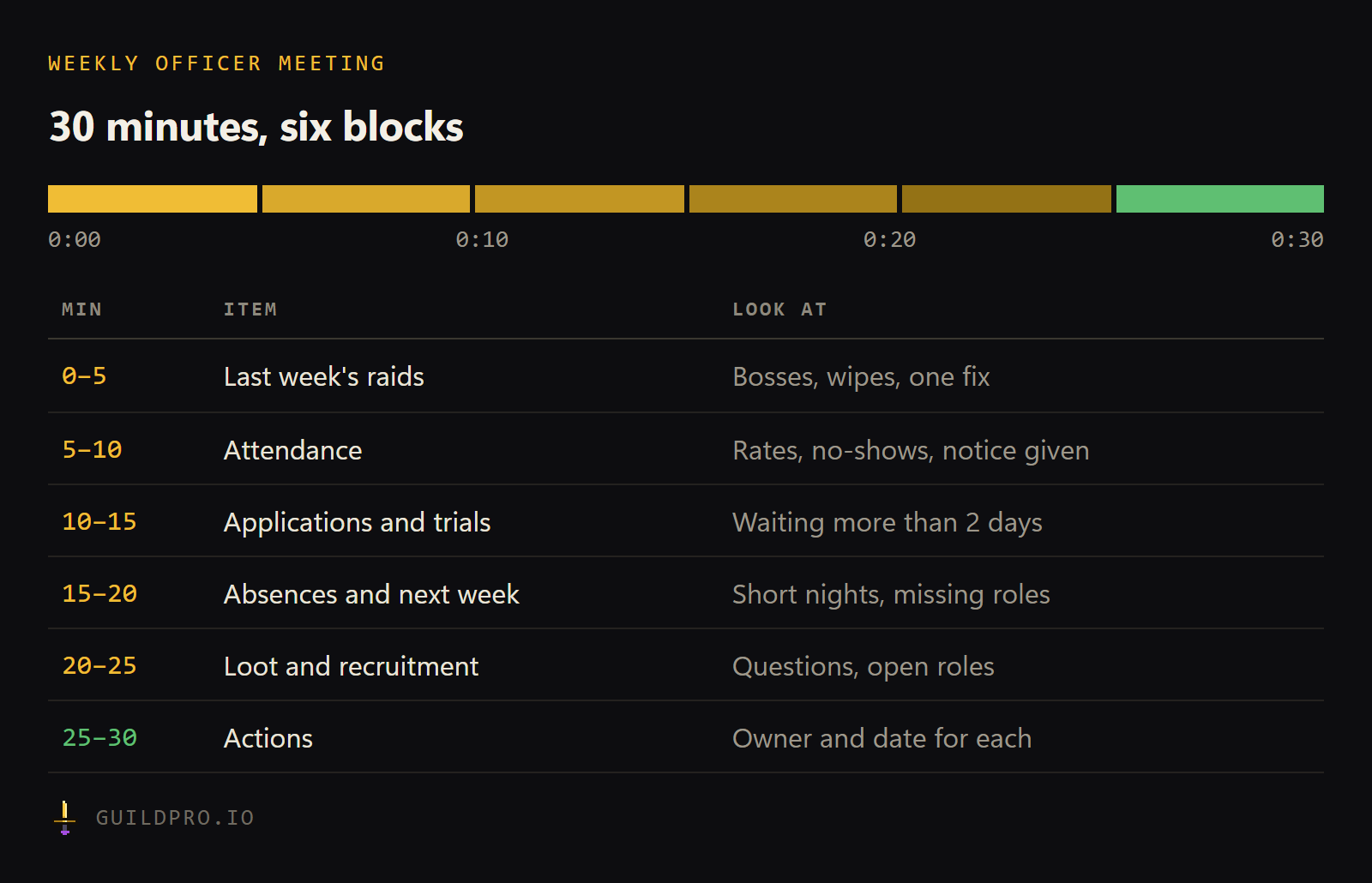
Six fixed items in the same order every week, then actions. A fixed order means nobody has to prepare a new agenda, and nothing important gets pushed to the end.
| # | Item | Time | What you look at |
|---|---|---|---|
| 1 | Last week’s raids | 5 min | Bosses, wipes, what went well, one thing to fix |
| 2 | Attendance | 5 min | Rates, no-shows, who gave notice |
| 3 | Applications and trials | 5 min | Waiting applications, trials due a decision |
| 4 | Absences and next week | 5 min | Who is out, which nights are short |
| 5 | Loot and recruitment | 5 min | Loot questions, open roles, the recruitment post |
| 6 | Actions | 5 min | Who does what, by when |
**Officer meeting · [day, date, time with time zone]**
Chair: [name] · Notes: [name] · Voice: [channel]

**Read before the meeting** (5 minutes, on your own)
- Attendance page: last 4 weeks
- Recruitment page: waiting applications and trials
- #loot-log and any loot questions in #officers
- Next week's signup sheets

**1. Last week's raids** (5 min)
- What went well:
- One thing to fix:

**2. Attendance** (5 min)
- No-shows to follow up:
- Notice given (excused, nothing to do):

**3. Applications and trials** (5 min)
- Applications waiting more than 2 days:
- Trials due a decision:

**4. Absences and next week** (5 min)
- Who is out:
- Nights that are short of tanks or healers:

**5. Loot and recruitment** (5 min)
- Loot questions raised this week:
- Open roles to recruit for:

**6. Actions** (5 min)
- [Action] · [owner] · [by when]

Parked for next week:
What should officers review before the meeting?
The numbers: attendance, applications, absences and loot. Read them on your own before the call, so the meeting is spent deciding, not scrolling.
- Attendance. Look for patterns, not single nights. One missed raid with notice is life. Three no-shows in a month is a conversation. An attendance policy written in advance makes this conversation easier.
- Applications and trials. Anything waiting more than 2 days needs an answer this week, even if the answer is “still talking”. Trials that end before the next meeting need a decision now.
- Absences. Who has said they’re out, and which nights that leaves short. A raider who logs an absence is helping you plan. Treat it that way. Ask raiders to log absences before the sheet goes up.
- Loot. Questions raised since last week, and anything that looked uneven in the loot record. If your rules have a 48-hour window for disputes, answer within it.
- Recruitment needs. Compare next week’s sheets with the roster you want. If the same role is short two weeks running, it goes in the recruitment post.
In GuildPro the review is two or three pages. Attendance shows each raider’s rate, no-shows and excused raids (notice on the signup sheet counts as excused), the Recruitment page lists waiting applications and trials, and Loot lists who has received what. See understand attendance.
How do you keep an officer meeting to 30 minutes?
Timebox every item, decide or park, and take any conversation about one member out of the meeting if it needs more than 5 minutes. Meetings run long for the same three reasons every time: nobody read the numbers, nobody wants to make the call, and one person’s situation takes over.
A few habits that work:
- Same time every week. Pick a slot outside raid nights, such as 30 minutes before a non-raid evening. Put it on the guild calendar so it doesn’t depend on someone remembering.
- A chair and a note-taker. The chair watches the clock and says “park it”. The note-taker writes actions as they’re agreed, not afterwards from memory.
- Decide, park or delegate. Every item ends one of three ways. “Let’s think about it” is parking without a date.
- Member issues get their own call. If a raider’s behaviour needs a real discussion, agree who will talk to them and when, and move on. Keep it private and write down what was agreed.
- No new topics in the last 5 minutes. Anything new goes to the top of next week’s list.
If an officer can’t attend, they post their view on any item they care about in the officer channel beforehand. Decisions still get made.
What should go in the minutes?
Two short records: private minutes for officers with every decision and action, and a public summary with only what changes for members. Post both within an hour, while everyone still agrees on what was said.
**Officer minutes · [date]** (post in #officers)
Present: [names] · Absent: [names, with any views they sent]

**Decisions**
- [Trial name] passes / extends to [date] / ends. Reason: [one line]
- [Application] accepted / declined. Reason: [one line]
- [Loot question]: [outcome]

**Actions**
- [Action] · [owner] · [by when]
- [Action] · [owner] · [by when]

**Parked for next week**
- [Item]
**This week from the officers** (post in #announcements)
- Raids: [nights and times]. Sheets are up in #signups.
- We're recruiting: [roles]. Know someone? Point them to [apply link].
- Welcome to our new members: [names, if they've agreed to be named].
- Rule or loot change: [one line, with the date it starts], or "none this week".
Questions? Ask in #ask-an-officer.Keep anything about a named member’s conduct, warnings or trial feedback in the private minutes only. The public summary should never surprise the person it’s about. That public post can also become the guild’s regular update, which our weekly announcement template expands into one post with raid nights, shout-outs and leaderboards.
When should the meeting change shape?
When the guild changes shape: the first raids, a new raid team, or a merger. The fixed agenda suits a guild of one or two teams. Forever has 10, 20 and 40-player raids from 9 December, so a guild may run several teams at once. When that happens, give each team leader the first 5 minutes for their own team, and keep the rest of the agenda guild-wide.
Patch weeks need a longer meeting. Blizzard is aiming for a major patch about every 4 months, per Wowhead’s patch cadence report, and a new raid is the right time to revisit loot rules, raid nights and roster size in one sitting.
What should you set up before the first meeting?
A time, a channel, a chair and the review pages. Then run the first one with the template above, even if half the items are empty. Ticks are saved in your browser, and Copy for Discord turns the list into a message for your officers.
- A weekly time outside raid nights, on the guild calendar
- A private #officers channel and a voice channel
- A chair and a note-taker for each meeting
- The agenda template pinned in #officers
- Attendance, applications and loot pages bookmarked
- A 2-day rule for answering applications
- Private minutes posted within an hour
- A public summary posted in #announcements
- A place to park items for next week
For everything else a new guild needs, work through the WoW Forever guild checklist, and when raids start, signups and rosters give the meeting its numbers.
FAQ
How often should guild officers meet?
Once a week, at the same time, for 30 minutes. A weekly slot stops decisions piling up in DMs, and a short one keeps officers turning up. Skip a week only if the agenda is empty.
What should a guild officer meeting cover?
Last week's raids and attendance, open applications and trials, absences coming up, loot questions, recruitment needs, and anything about members that needs a decision. Then actions, each with a name and a date.
How do you keep an officer meeting short?
Timebox each item, read the numbers before the meeting instead of during it, decide or park every item, and move any member discussion that needs more than 5 minutes to its own follow-up.
Should officer meeting minutes be shared with the guild?
Share decisions, not discussion. Post a short public summary of what changed for members, and keep notes about named members in the private officer channel.