Guild officer roles in WoW: who does what
Guild officer roles in WoW, split cleanly: guild master, raid leader, class leads, recruitment, loot and community. What each one owns, plus a duties post.
In this post
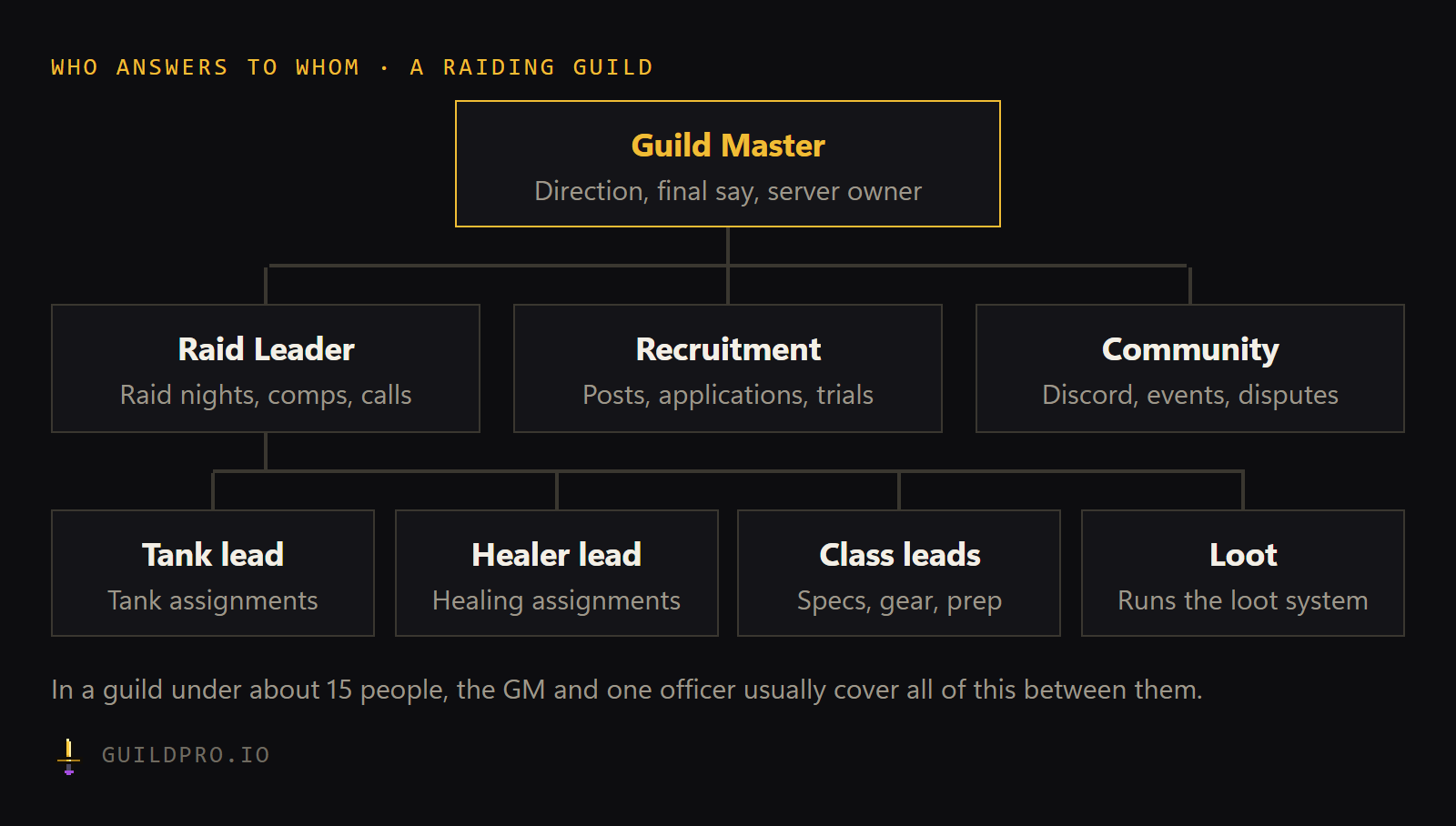
A raiding guild needs six jobs covered: guild master, raid leader, class leads (tank and healer leads included), recruitment, loot and community. Each job needs one named owner. In a small guild one person holds several, and that is fine, as long as everyone knows who to ask.
Most officer trouble isn’t about bad officers. It’s about two people who each thought the other one was handling recruitment, or a raid leader who is also expected to settle every argument in Discord. Writing down who owns what fixes most of it. This page splits the jobs, shows how they fit together, and ends with a duties post you can pin.
What officer roles does a WoW guild need?
One owner for direction, raid night, class knowledge, recruitment, loot and the community. Titles vary between guilds. The jobs don’t.
What does each officer role do?
Pick a tab to see what each role owns, what it doesn’t, and roughly how much time it takes in a week.
Guild master
Owns: the guild’s direction, its rules, who becomes an officer, and the final say when officers disagree. Usually owns the Discord server too.
Doesn’t own: raid night. A guild master who also leads raids should say which hat they are wearing.
Week to week: an officer meeting, a check on recruitment and morale, and stepping in when a problem goes past one officer.
Watch for: doing every job personally. A GM who runs everything burns out by the second raid tier.
Raid leader
Owns: raid night. Signups, the roster and comp for each raid, assignments, pulls and calls, and the call to stop for the night.
Doesn’t own: loot decisions alone, or recruitment. The raid leader says what the roster needs. Someone else finds the people.
Week to week: post signups, build the comp, read the recap afterwards, and plan the next night. Raid size matters here: Forever’s first raids on 9 December are Barrow Deeps for 10, Hyjal Summit for 20 and Onyxia’s Lair for 40, per Wowhead’s raids overview. A 40-player night needs more help than a 10.
Watch for: a leader who never gets to play. Hand assignments to the class leads.
Class leads
Owns: knowledge of one role or class. Tank lead sets tank assignments. Healer lead sets healing assignments. Class leads keep specs, talents, gear and consumables in order for their class.
Doesn’t own: who gets a raid spot. They advise the raid leader.
Week to week: check their players are prepared, answer questions, and share changes. Forever has new talents and new race and class combinations, so expect more questions than usual. The Wowhead Forever class guides are a good shared reference.
Watch for: a class lead who becomes a second raid leader mid-pull. One voice on comms.
Recruitment
Owns: the recruitment post, the listing on recruitment boards, applications, interviews and trials.
Doesn’t own: what the roster needs. The raid leader decides that, the recruiter finds it.
Week to week: refresh the post where the rules allow, answer applicants within a day or two, and follow up on trials. Our recruitment guide has a post template.
Watch for: applications sitting unanswered. A good applicant joins whoever replies first.
Loot
Owns: running the loot system the guild agreed on, keeping its records, and answering loot questions after the raid.
Doesn’t own: choosing the system alone. The GM and officers choose, the loot officer runs it.
Week to week: hand out loot on raid night, keep the record straight, and post standings if the system uses them. If you haven’t chosen a system yet, read loot council vs DKP.
Watch for: the loot officer winning a contested item. Have a rule for it, such as another officer deciding.
Community
Owns: the Discord, events outside raids, welcoming new members, and the first response to arguments between members.
Doesn’t own: removing people. That goes to the GM.
Week to week: keep channels and roles tidy, run a social event, and check in with quiet members. During levelling, this is often the busiest officer.
Watch for: being the only person anyone talks to about problems. Share it.
Which roles can one person hold?
Pair jobs that don’t clash on raid night. The raid leader should never also be the person running loot or answering applications during a pull.
| Guild size | A split that works |
|---|---|
| Under 15 | Guild master (also community and recruitment), one raid leader (also loot) |
| 15 to 40 | Guild master, raid leader, recruiter, loot, a tank lead and a healer lead |
| 40 and up, or more than one raid team | All six jobs, a raid leader per team, and class leads for the big classes |
How do officer roles map to Discord and the guild page?
Give people the permissions their job needs, and no more. A loot officer doesn’t need to edit channels. A recruiter needs the private applications channel.
GuildPro has three roles, set on the guild page rather than by Discord roles: raider, officer and admin. Officers run raids, rosters, recruitment and surveys, and can use the comp builder and the control panel. Admins also change roles, guild settings, raid teams and channel routes. If the guild runs more than one game, admins and officers are set per game. Ranks and admins.
In practice: the guild master and one trusted officer are admins. Raid leaders, recruiters and the loot officer are officers. Class leads can stay raiders unless they help build comps in the comp builder. For the Discord side, our guild Discord template post has rank roles that match these jobs.
How do I write down officer duties?
One pinned post in the officer channel, one line per job, with a name beside each. Copy this and change the brackets.
**Who does what**

**Guild master · [name]**
Direction, rules, officer picks, final say. Ask about: anything that crosses two jobs.

**Raid leader · [name]**
Signups, roster and comp, assignments, calls on raid night. Ask about: raid spots, raid times.

**Tank lead · [name]  ·  Healer lead · [name]**
Assignments and prep for their role. Ask about: specs, gear, consumables.

**Recruitment · [name]**
Recruitment post, applications, trials. Ask about: joining, bringing a friend.

**Loot · [name]**
Runs our loot system: [system]. Ask about: loot rules, standings.

**Community · [name]**
Discord, events, welcoming people. Ask about: channels, roles, problems with another member.

Officer meeting: [day and time]. Changes to this list are posted in #announcements.
Post a public version in your rules channel, without the meeting line, so members know who to ask.
How do officers stay on the same page?
A short weekly meeting, decisions written down, and one voice in public. Officers can disagree in the officer channel. Once decided, everyone backs the decision.
- Meet weekly, briefly. 20 minutes after a raid night works for many guilds.
- Write decisions in the officer channel. “We agreed” with no record turns into “I never agreed”.
- Review roles after a month. Launch is chaotic. Some people will be better suited to a different job than the one they started with.
For the rest of the launch prep, work through the WoW Forever guild checklist.
FAQ
What is the difference between a raid leader and a guild master?
The guild master owns the guild: its direction, its rules and the final say. The raid leader owns raid night: the roster, the comp and the calls. In a small guild one person often does both, but they are different jobs.
How many officers does a WoW guild need?
Enough that every duty has one owner. A guild under about 15 people can manage with a guild master and one officer. A guild raiding 40-player content usually needs a raid leader, a recruiter, a loot owner and class leads as well.
Should officers be chosen by vote?
Usually not at launch. Pick people who already do the job well, give them a trial month, and review. Votes work better once the guild knows each other.
What permissions should officers have in Discord and on the guild page?
Only what their job needs. In GuildPro, officers can run raids, rosters, recruitment and surveys, while admins also change roles, settings, raid teams and channel routes. See ranks and admins.