Loot council vs DKP in 2026: picking a loot system
Loot council vs DKP, EPGP, soft reserve and rolls, compared fairly for a new WoW Forever guild with 10, 20 and 40-player raids. Plus a quiz to pick one.
In this post
- What are the main WoW loot systems?
- How do loot council and DKP compare?
- How does Forever’s raid size change the choice?
- When does loot council work best?
- When do DKP and EPGP work best?
- When do soft reserve and rolls work best?
- How do I introduce a loot system to the guild?
- How do I keep a record of who got what?
Loot council gives the most control, DKP and EPGP give the most transparency, and soft reserve and rolls are the quickest. For a new WoW Forever guild, match the system to the raid: on 9 December Barrow Deeps opens for 10 players, Hyjal Summit for 20 and Onyxia’s Lair for 40. Many guilds will use a light system for the small raids and a heavier one for the 40.
Loot is the most common reason guilds fall out, and the arguments rarely come from the system itself. They come from a system nobody agreed on, or one that changed after the first good drop. This page compares the five common systems as fairly as we can, then helps you pick. Decide before 9 December and write it down.
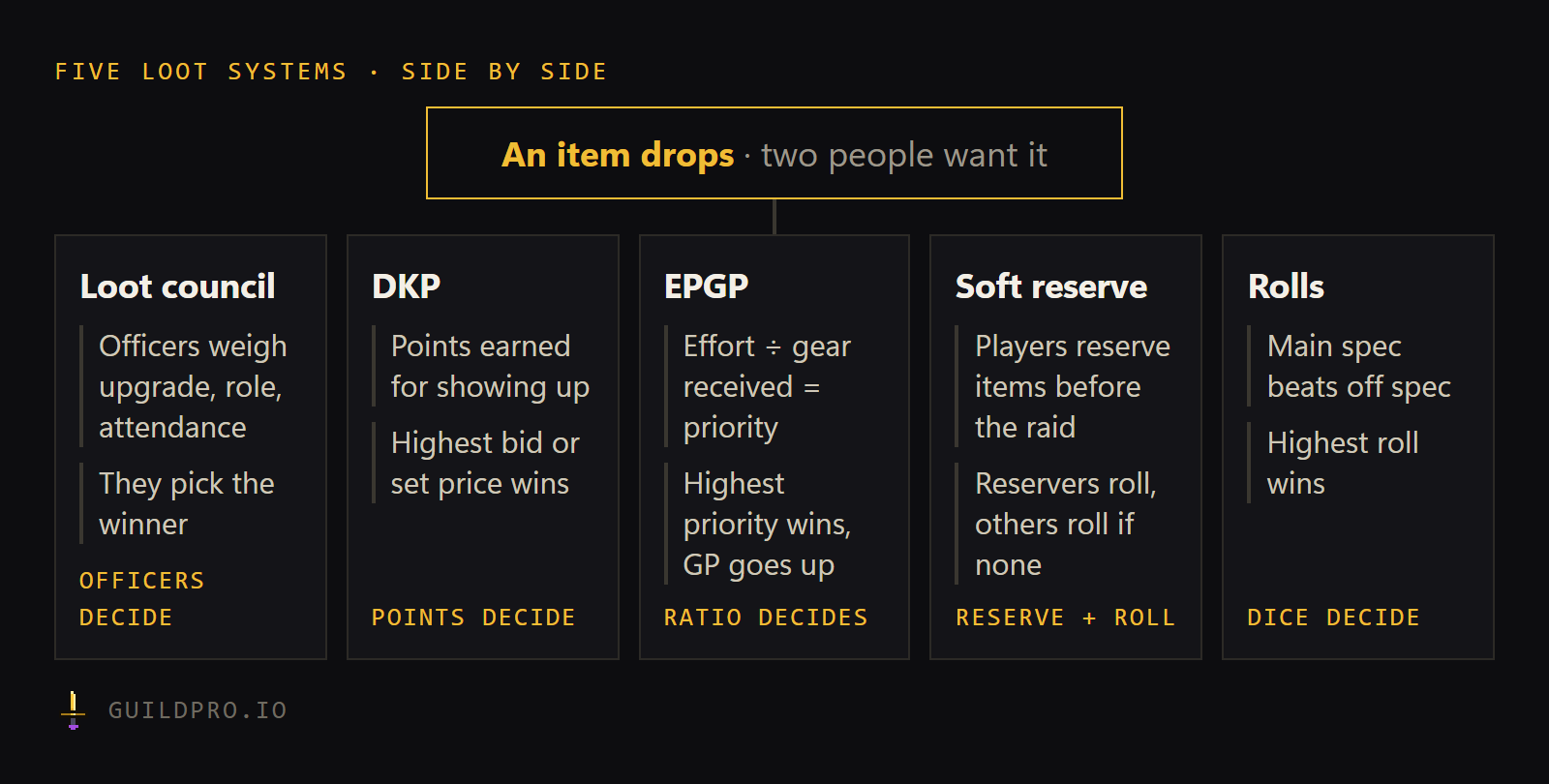
- Loot council: officers decide. Best when the guild trusts its officers.
- DKP: points for attendance, spent on items. Transparent, rewards loyalty.
- EPGP: priority from effort over gear, with decay. Fair to newcomers.
- Soft reserve: reserve items before the raid, roll among reservers. Light and quick.
- Loot rolls: main spec over off spec, highest roll wins. No admin.
What are the main WoW loot systems?
Loot council, DKP, EPGP, soft reserve and plain rolls. Each answers the same question, “two people want this item, who gets it?”, in a different way.
Blizzard hasn’t detailed how loot is distributed inside Forever’s raids yet. Whatever the in-game loot method turns out to be, these systems are the guild’s rule for who should get the item. Check the in-game options when raids open.
How do loot council and DKP compare?
Loot council trades transparency for speed and efficiency. DKP trades efficiency for transparency and a reward for attendance. EPGP, soft reserve and rolls sit around them.
| System | Who decides | Strengths | Weaknesses | Officer work |
|---|---|---|---|---|
| Loot council | 3 to 5 officers | Gear goes where it helps the raid most; fast | Depends on trust; accusations of favouritism | Medium on the night, plus records |
| DKP | Points (bids or set prices) | Transparent; rewards attendance | Slow; points hoarding; newcomers start behind | High: points every raid |
| EPGP | Effort ÷ gear ratio | Fair to newcomers; decay stops hoarding | Hardest to explain; needs a tool | High: EP, GP and decay |
| Soft reserve | Reservation, then a roll | Quick; everyone knows their target item | Luck decides ties; less control on key items | Low: collect reserves |
| Loot rolls | The dice | No admin at all; feels fair | Can gear the wrong people for progress | None |
How does Forever’s raid size change the choice?
Small raids favour light systems, the 40-player raid favours heavier ones. Per Wowhead’s raids overview, the first three raids are different sizes: Barrow Deeps for 10, Hyjal Summit for 20, and Onyxia’s Lair for 40. Bosses and loot tables aren’t announced yet.
- 10 players. Few people want the same item. Soft reserve or rolls are quick and rarely cause trouble. Alt groups often run this size, which suits a light system. Our main and alt policy guide covers how alts and loot interact.
- 20 players. The middle ground. Either works. Pick based on how settled your roster is.
- 40 players. Many contested items and many people watching. This is where loot council, DKP and EPGP earn their admin.
More raids are coming. Wowhead’s roadmap lists two new raids in spring 2027. A system you set up now will need to run for a long time, so prefer one your officers can keep up.
When does loot council work best?
When the officers are trusted, the criteria are published, and every decision is written down. Loot council is the quickest way to get key items to the people who make the raid stronger, which is why progression guilds like it.
It fails when members can’t see why an item went where it did. Publish the criteria, such as upgrade size, role priority and attendance, and keep the loot officer out of decisions on their own items.
When do DKP and EPGP work best?
When the guild values being rewarded for showing up, and someone is willing to keep the numbers. Both systems run on attendance, so the attendance record has to be right. That includes the bench: a raider who signed up and sat out should usually earn points too.
DKP is easier to explain. EPGP is fairer to newcomers because of decay. Settle the details before the first raid: how points are earned, whether you bid or use set prices, and how decay works.
When do soft reserve and rolls work best?
For small raids, alt runs, and guilds that would rather play than administer. Soft reserve gives everyone a target and stops the “I wanted that” argument after the drop. Rolls need nothing at all.
The risk is progress. If one trinket decides whether your tank survives a boss, luck is a poor way to hand it out. Some guilds roll on most items and keep a short list of key items for officers to assign.
How do I introduce a loot system to the guild?
Agree it before the first raid, write it in one pinned post, and promise not to change it mid-tier without notice. The fastest way to lose trust is to change the rules right after someone loses an item under them.
A loot post that works covers five things:
| Item | Example |
|---|---|
| Which raids it applies to | Soft reserve in the 10, loot council in the 40 |
| Who decides ties | The loot officer, or two officers if it is their own item |
| How alts are treated | Alts take items no main in the raid needs |
| How trials are treated | Trials can win items nobody else needs for their first 2 weeks |
| How to appeal | Ask the loot officer after the raid, never during it |
Run the first raid night as a trial of the system, and ask for feedback the week after. Small fixes then are cheap. Small fixes three months in feel personal.
How do I keep a record of who got what?
Record every drop, the winner and the raid, and keep it where every raider can see it. Whichever system you pick, the record is what settles arguments.
GuildPro records loot. The addon notes what dropped and who received it, and after
the raid the guild’s Loot page shows it by raider (item count, days since their
last item) and as a list of every drop. Recaps put each drop under its boss, with the
winning roll where there was one, and /loot posts recent epic drops in Discord.
GuildPro doesn’t hand out loot or run DKP, council voting or priority, so it works
alongside any system above. Loot history.
To ask the guild before deciding, a short poll in Discord is enough. Then pin the rule next to your other policies, and list it on your recruitment post: applicants ask about loot second only to raid nights.
For everything else to settle before the first raids, work through the WoW Forever guild checklist. The GuildPro app installs the addon that keeps the loot record on Forever.
FAQ
Is loot council better than DKP?
Neither is better everywhere. Loot council gets items to where they help the raid most but depends on trusting the officers. DKP is transparent and rewards attendance but is slower and can hand gear to whoever saved points longest.
What is the difference between DKP and EPGP?
DKP spends points you earned by attending. EPGP divides effort points by gear points to get a priority, and decays both over time, so new members catch up faster and nobody hoards points.
What loot system is best for a 10-player raid?
Usually soft reserve or plain rolls. With 10 players there are few contested items, and a light system is quicker on the night. Bigger systems pay off in 20 and 40-player raids.
Can a guild use different loot systems for different raids?
Yes, and many do. A common split is soft reserve for small raids and loot council or points for the 40-player raid. Write down which applies where.
Does GuildPro run DKP or loot council?
No. GuildPro records what dropped and who received it, which works with any loot system. It has no DKP, council voting or priority tools. See loot history.