WoW main and alt policy for a new Forever guild
Write your guild's main and alt rules before WoW Forever launches, not after the first loot fight. A copyable policy, a quiz, and how to collect mains.
In this post
- Why does a Forever guild need an alt policy before launch?
- What should a main and alt policy cover?
- What does a good alt policy look like?
- How strict should the policy be?
- How do I find out who is playing what before launch?
- When should players lock in their main?
- What are the common mistakes with alt rules?
A WoW main and alt policy says what counts as a main, when alts can raid, how loot splits between them, and how to change mains. Write it before WoW Forever launches on 4 November. Expect alts: the Legacy system rewards levelling more than one class, and the first raids on 9 December include a 10-player one that alts can fill.
Every guild ends up with a main and alt policy. The only choice is whether you write it calmly in October or invent it in a raid, mid-argument, over the first good drop. This page gives you a policy you can paste, a quiz to pick the right strictness, and a way to find out who is playing what before anybody hits level 60.
- Mains first, alts welcome: one main for raid spots and loot, alts fill gaps. Suits set nights and council or points loot.
- Open roster: any character can raid, loot by roll or soft reserve.
- An alt team: mains on the main team, alts in a second group on another night.
Why does a Forever guild need an alt policy before launch?
Because the questions it answers come up in the first raid, and by then everyone already has a stake in the answer. In October nobody has a level 60 yet, so nobody is arguing for their own character.
Three things about WoW Forever make this matter more than usual:
- Alts are rewarded. The Legacy system gives account-wide points for levelling each class to 25, 45 and 60, among other challenges. Players who chase Legacy Points will level more than one class.
- New race and class combinations. Blizzard has confirmed new combinations such as Undead Paladin, Dwarf Shaman and Orc Mage, plus the Skyborne race. Many players will want to try two of them before settling.
- Three raid sizes on day one of raiding. On 9 December, per Wowhead’s raid overview, Barrow Deeps opens for 10 players, Hyjal Summit for 20 and Onyxia’s Lair for 40. A 10-player raid is exactly the size where alts end up running together.
What should a main and alt policy cover?
Five things: what a main is, how to change it, when alts raid, how loot splits, and which characters count at all. Anything longer than a screen will not be read.
| Rule | The question it settles |
|---|---|
| What a main is | Which character holds your raid spot and your loot priority |
| Changing mains | How much notice, and what happens to your loot history |
| Alts in raids | When an alt can take a spot, and who decides |
| Alt loot | Whether an alt can win an item a main still needs |
| Which characters count | Same ruleset and faction as the guild, so they can actually group |
That last row is new for Forever. There are no realms, only rulesets, and characters on different rulesets cannot group. Collections and Legacy Points are shared across all rulesets except Hardcore, so a player can level an alt on another ruleset for the points. That alt still cannot join your raids. Say so in the policy, so nobody is surprised.
What does a good alt policy look like?
Short, specific, and written so a new member can follow it without asking. Copy this, change the bracketed parts, and pin it in your rules channel.
**Main and alt policy**

**Your main**
- Your main is the character you raid on and get loot priority with.
- Register it on the roster call in #roster-call by [date].
- One main per person. It must be on our ruleset ([ruleset]) and faction ([faction]).

**Changing your main**
- Tell an officer at least [2 weeks] before you switch.
- Your attendance stays with you. Loot priority starts again on the new main.
- No main changes during [the first month of a new raid].

**Alts in raids**
- Mains get raid spots first.
- An alt can take a spot when the raid needs that role and no main can fill it.
- Sign up on the character you are actually bringing.
- Alt groups for [Barrow Deeps / other nights] are welcome. Ask in #signups.

**Alt loot**
- An alt can take an item when no main in the raid wants it.
- Alt loot never counts against your main.

**Alts on other rulesets**
- Fine to level them, and they still earn Legacy Points.
- They cannot group with us, so they are not part of the guild roster.

Questions go to [officer name or #officers]. Rules can change, and we will post here when they do.
Notice what the template leaves out: a numbered list of exceptions. Write the principle and let officers judge the edge cases. Long policies invite rules-lawyering.
How strict should the policy be?
As strict as your loot system and raid nights need, and no stricter. A guild that raids twice a week with a loot council needs a clear main because council decisions depend on it. A guild that rolls for everything barely needs the word “main”.
Strict: one main, alts by invitation
Mains get spots and loot first. Alts come when the raid leader asks. This is the usual pick for guilds pushing for early kills.
Relaxed: bring what the raid needs
Any character can raid, and loot goes by roll. The one rule that stays is “sign up on the character you are bringing”, because attendance and loot records are kept per character.
Two groups: a main team and an alt team
With 10, 20 and 40-player raids open at once, a bigger guild can run the 40 on mains and let a smaller group take alts through the 10. Keep loot on each team separate.
How do I find out who is playing what before launch?
Ask every member for a main and their likely alts, by class and spec, before 4 November. Eight rogues and two healers is easy to fix now and hard to fix in December. Alt lists matter as much as mains: your missing healer is often an alt someone would play if asked.
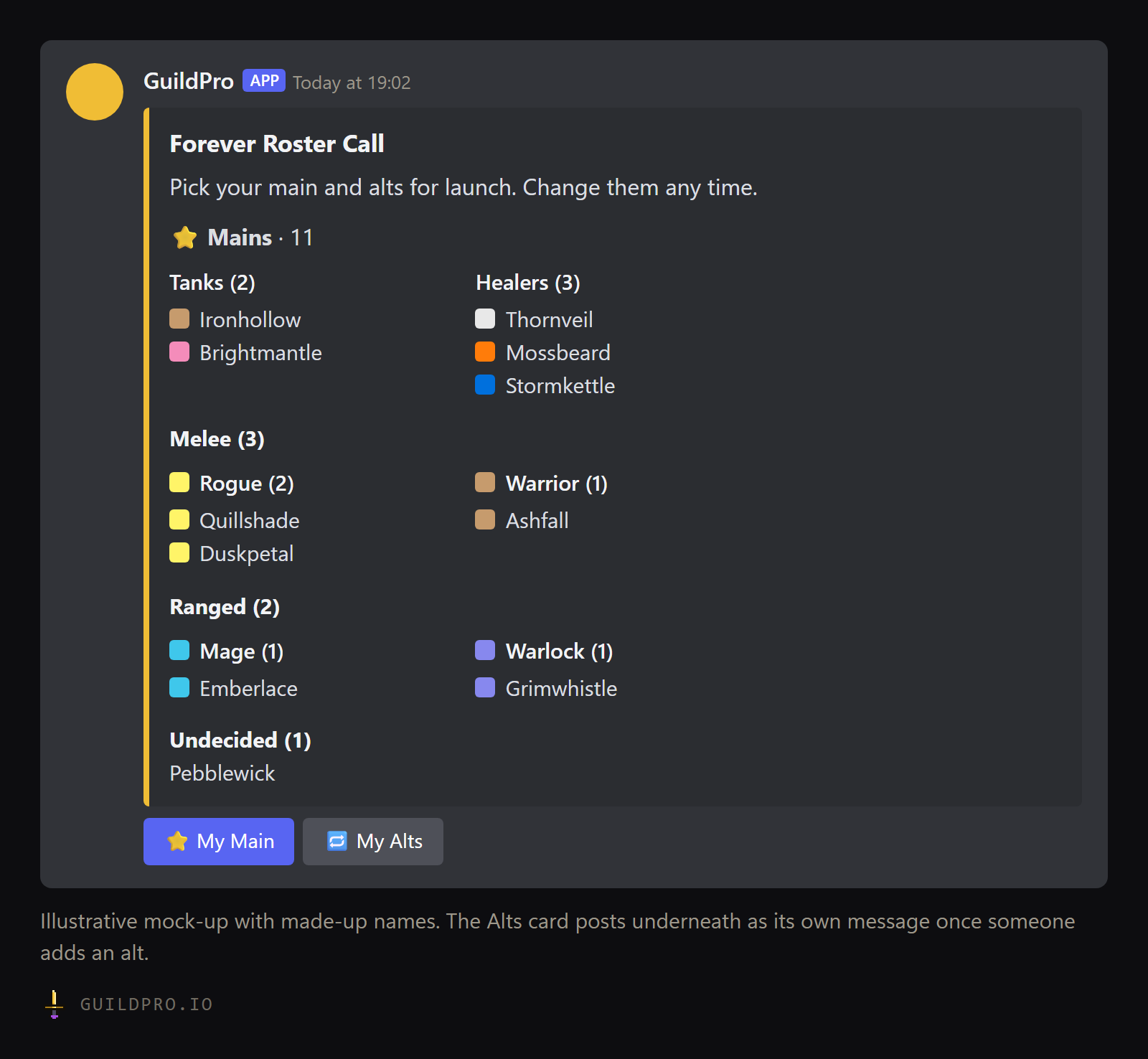
In GuildPro an officer types /rostercall in Discord. The bot posts a Mains card with
My Main and My Alts buttons. Each person picks a class and spec for one main
and up to 5 alts, or Undecided, and nobody needs an account to answer. Alts get
their own card under the Mains one. The answers also show on the Forever guild page as
a preliminary roster. How /rostercall works.
Once launch comes and people claim their real characters, each person’s characters sit together on one row of the guild’s member list, so officers can see whose alt is whose. See Members and alts.
When should players lock in their main?
Collect answers before launch, then set a firm date before 9 December. Between 4 November and the first raids, people will level, try classes and change their minds. That is fine. What you want is a date after which a switch needs notice.
| When | What to ask for |
|---|---|
| Now to 3 November | A likely main and alts on the roster call, Undecided allowed |
| Name reservation, 27 October to 3 November | Up to 3 reserved characters in total across all rulesets, so ask people to reserve their main’s name first. See our name reservation guide. |
| 4 November to early December | Level, test, change your mind. Post a fresh roster call if a lot has changed. |
| A week before 9 December | Mains are set. Changes after this need officer notice. |
What are the common mistakes with alt rules?
Writing them too late, writing them too long, and not enforcing the one about signups.
- Silent main swaps. Someone gears a second character and turns up on it without saying. The notice rule exists to stop this.
- Alt loot over a main’s need. Decide the order once. The template says mains first.
- Signing up as one character and bringing another. Attendance is matched by character name and loot is recorded per character, so this quietly breaks your records.
- Alts on the wrong ruleset. They cannot group with you, however keen the player.
Pin the policy, link it from your welcome message, and point at it the first time it comes up. For the rest of the launch prep, the WoW Forever guild checklist has every step in order, and GuildPro’s signups and rosters show how mains and alts carry through to raid night.
FAQ
What is a main and alt policy in a WoW guild?
A short set of rules that says what counts as your main, when you can bring an alt to a raid, how loot is shared between them, and how to change mains. It is pinned in Discord so nobody argues it during a raid.
Should a new WoW Forever guild allow alts in raids?
Usually yes, with mains first. The Legacy system rewards levelling more than one class, so most players will have alts, and alts often fill the gaps in a 10-player raid.
When should players lock in their main for WoW Forever?
Ask before launch on 4 November, then set a firm date before the first raids open on 9 December. A change after that should need notice to an officer.
Do alts on another ruleset count for the guild?
No. Characters on different rulesets cannot group, so an alt on another ruleset cannot join your raids. It still earns Legacy Points for the player's account.
How do I find out who is playing what before launch?
Run a roster call in Discord. GuildPro's /rostercall posts a sheet where each member picks a main and up to five alts, or Undecided, with no account needed.