How to handle guild drama: an officer playbook
How to handle guild drama as a WoW officer: loot disputes, bench resentment, personality clashes and people leaving, with templates for the hard messages.
In this post
To handle guild drama, take it out of public chat, talk to each person privately, check what happened against your written rules and records, decide as officers, and tell people the outcome plainly. Most guild drama is loot, the bench, two people who clash, or someone leaving. Each has a playbook below.
Every guild gets drama. Launch weeks bring it early, because people who met three days ago are suddenly sharing loot and raid spots. In Forever the first raids open on 9 December, so the first loot arguments haven’t happened yet in most guilds. That’s the best time to read this. The calm guilds aren’t the ones without conflict. They’re the ones whose officers handle it the same way every time.
What is the first thing to do when guild drama starts?
Move it out of public chat and say when you’ll answer. “Let’s take this to DMs. Officers will get back to you by Sunday” stops an audience forming, and an audience is what turns a complaint into drama.
Then work the same steps every time:
- Listen privately to each side. Separately, and before you decide anything.
- Check the facts. Your written rules, the signup sheet, the loot record, the chat log. Memory is the weakest source in any argument.
- Decide as officers. One officer deciding alone is how “the officers play favourites” starts.
- Tell the people involved, in plain words. Then, if it was public, post a short public line that it’s been handled.
- Write down what you decided. Next time, the same situation gets the same answer.
How do I handle the most common kinds of guild drama?
Each kind has its own cause and its own fix. Pick the situation you’re dealing with.
Loot disputes
What it looks like: “Why did they get it? I’ve been here longer.” Usually after a contested drop, often in raid chat while everyone is still in the instance.
What to do:
- Don’t reverse a drop mid-raid. Say “we’ll look at it after” and move on.
- After the raid, check the drop against your written loot rules and your loot record.
- If the rules were followed, explain once, privately, with the rule. Don’t argue it twice.
- If the rules weren’t followed, admit it, and fix the process for next week. Don’t take an item back from someone who received it in good faith.
Prevent it: write the loot rules down before 9 December, including tiebreaks and how trial members are treated. Forever helps a little here: dungeon drops award appearances to the whole group, per Wowhead’s dungeon guide, so arguments over looks shouldn’t follow you out of dungeons. Our loot council vs DKP post compares the systems.
Attendance and bench resentment
What it looks like: “I always sign up and always get benched.” Or the opposite: “Why does someone who misses half the raids get a seat?”
What to do:
- Look at the record before the conversation, not during it.
- Tell the person how the bench is chosen this tier, and where they stand.
- If you’ve been benching the same person every week, rotate it, and say so.
Prevent it: publish the bench rules and credit people for being benched. Being asked to sit out shouldn’t cost someone their standing. Write down the main and alt rule too. Forever’s Legacy system rewards levelling alts, so expect people to ask to bring one.
Personality clashes
What it looks like: two members who snipe at each other in chat, a raider who’s sharp with newer players after wipes, a joke that keeps landing badly.
What to do:
- Talk to each person privately, about behaviour, not character. “The comments after the third wipe” rather than “your attitude”.
- Ask what they need to keep raiding together. Sometimes it’s a different group, or different channels.
- Don’t make two adults shake hands in public.
Prevent it: a short code of conduct in your rules, and a raid leader who resets the tone after wipes.
Someone leaving
What it looks like: a raider who goes quiet, then posts a long goodbye, or simply leaves the guild overnight.
What to do:
- Thank them and wish them well, publicly if they posted publicly.
- Ask once, privately, if there was something you could have done better. Listen. Don’t argue.
- If they were a key role, tell the raid team your plan before rumours start.
Prevent it: check in with quiet regulars before they’re gone. A quick “how’s the guild feeling for you?” catches a lot.
Disputes are easier when everyone looks at the same record. GuildPro keeps a loot history from what the addon saw, by raider and by drop, and every guild member can open it. Attendance counts the bench: someone who signed up and wasn’t seated in the comp builder is credited for that raid, not marked absent. GuildPro records loot. It doesn’t decide it, so it works with any loot system. How loot history works.
What should I say in a hard message?
Say what happened, what the rule is, what happens next, and nothing else. Short messages are kinder than long ones, and they leave less to argue with. Copy these and fill in the brackets.
Hey [name], I saw the messages in [channel] about [topic]. Let's take this to DMs so it doesn't turn into a thread. I want to hear your side properly. Officers will get back to you by [day].Hi [name]. I looked at [item] from [boss] on [date]. Under our loot rules, [rule in one line], and that's why it went to [name]. I know that's frustrating. Your [position / priority / points] stands, and you're [next in line / near the top] for the next one. Happy to talk it through in voice if you'd like.Hi [name]. I need to talk to you about [specific behaviour] on [date]. That's against our guild rule on [rule], and it needs to stop. This is a first warning, and it's between you and the officers. If it happens again, [what happens next]. If something's going on that we should know about, tell me.Hi [name]. The officers have decided to remove you from the guild. After the warning on [date], [what happened again] on [date]. We won't be changing the decision. Thanks for the time you spent with us, and good luck in Forever.When should I remove someone from the guild?
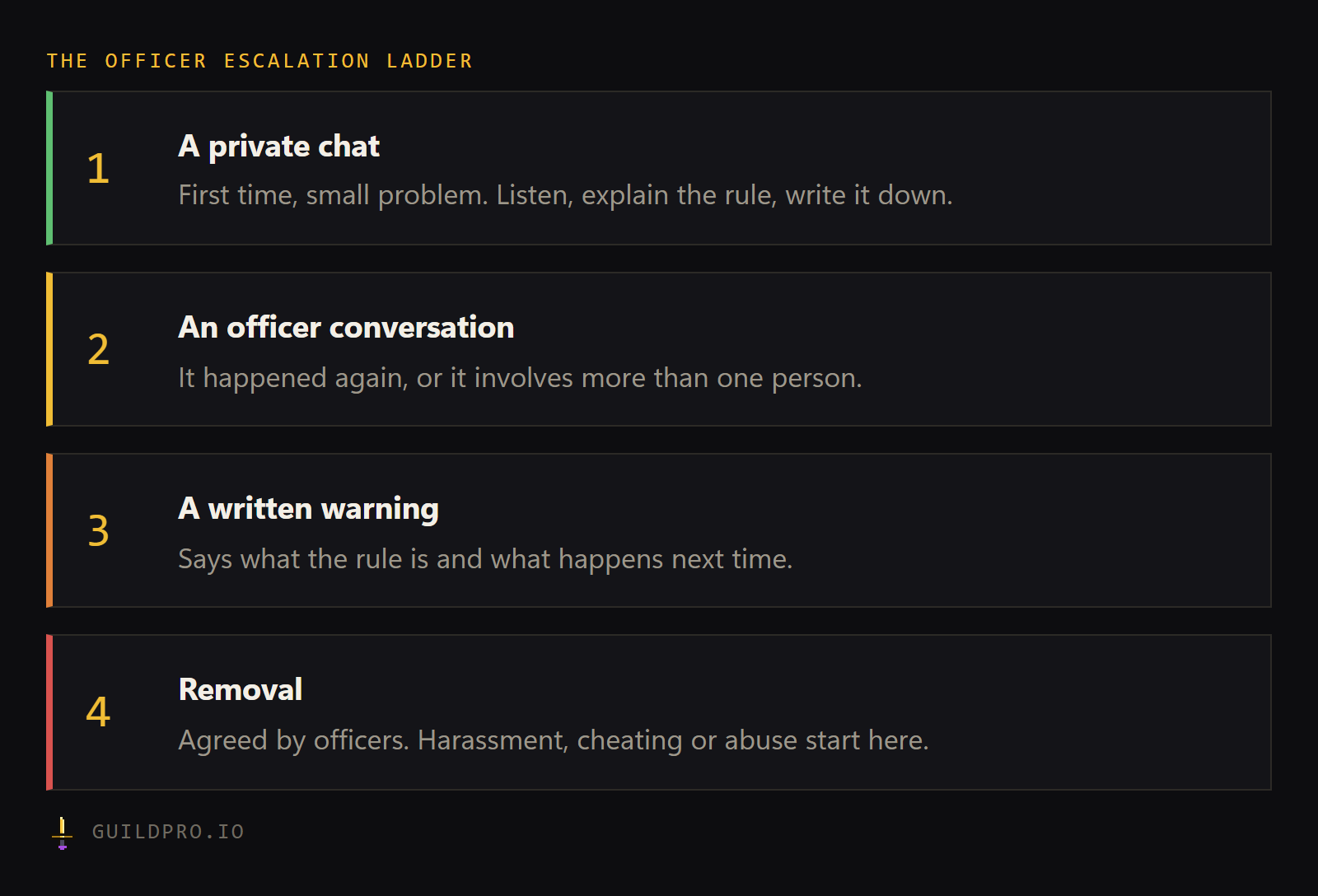
After a clear warning and a repeat of the same problem, or straight away for harassment, cheating or abuse. Removal should be agreed by officers, not done by one person at midnight after a bad wipe.
| Situation | What to do |
|---|---|
| A first-time rule break | Private conversation, written down |
| The same break, after that conversation | Written warning, saying what happens next time |
| The same break, after the written warning | Removal, agreed by officers |
| Harassment, slurs, threats | Removal at once, and remove from Discord too |
| Cheating, scamming members, selling guild loot | Removal at once |
| Sharing private messages to cause trouble | Warning, then removal |
Before you remove someone, make sure the rule they broke was actually written down and shared. If it wasn’t, the warning is the fix, not the removal. Our guild rules template is a good place to start.
How do officers stay out of the drama themselves?
Agree how you’ll handle it before it happens, keep officer talk in the officer channel, and never decide alone about a friend. Officers are members too. They have friends, favourites and bad nights.
- Step back when it’s personal. If the dispute involves your friend or partner, another officer takes it.
- Present one decision. Disagree in the officer channel, then speak with one voice.
- Rotate the hard conversations. One officer who always delivers bad news burns out. Our guide to officer roles covers splitting the work.
- Log off. A message sent at 1:00 after a wipe night is rarely the one you’d send the next morning.
Raids in Forever open on 9 December, per Wowhead’s raids overview. The rules, records and officer habits you set before then are what keep the guild calm when the first contested drop lands. For the rest of what to settle first, see the WoW Forever guild checklist.
FAQ
How should officers handle guild drama?
Move it out of public channels, talk to each person privately, check the facts against your written rules and records, decide as officers, and tell the people involved the outcome in plain words. Most drama shrinks once it's private and has a date for an answer.
How do I handle a loot dispute in a WoW guild?
Point to the written loot rules and the record of who received what. If the rules were followed, explain the decision once. If they weren't, say so, fix it for next time, and don't reverse a drop in the middle of a raid.
When should a guild remove a member?
When someone has had a clear private warning and broken the same rule again, or for harassment, cheating or abuse at the first instance. Removal should be agreed by officers, not decided by one person in the heat of the moment.
What do I say when a raider leaves the guild?
Thank them, wish them well, and keep it short. Ask once, privately, whether there was something the guild could have done better. People who leave on good terms often come back or send friends.