WoW Forever legacy system: what it means for a guild
WoW Forever's legacy system gives account-wide points for levelling classes, professions and PvP. Why it rewards alts, and how a guild can plan alt nights.
In this post
- What is the legacy system in WoW Forever?
- How do you earn Legacy Points?
- Why does the legacy system reward alts?
- Do alts on another ruleset or faction matter to the guild?
- What does the respec at the class trainer mean?
- What does the legacy system mean for a guild’s alt policy?
- How do you run a guild alt night?
The WoW Forever legacy system gives your account points for levelling each class to 25, 45 and 60, for professions, PvP ranks, dungeons, raids and exploring. You spend them on account-wide non-combat perks in a Legacy Tree, and you can respec at the class trainer. Because every class you level earns points, Forever rewards alts. A guild should plan for them instead of fighting it.
What is the legacy system in WoW Forever?
An account-wide progression system: challenges earn Legacy Points, and you spend the points in a Legacy Tree on perks that don’t affect combat. There are also cosmetic rewards at milestones.
That’s the summary in Wowhead’s legacy system overview, which lists the challenges and rewards in full. Point values and the exact perks can still change, so read them there rather than from a table copied before launch.
The key word for a guild is account-wide. Points don’t belong to your main. They belong to you, and every character you play adds to them.
How do you earn Legacy Points?
From challenges across the game: levelling classes, raising professions, PvP ranks, battleground reputations, dungeons and raids, and exploring. The levelling and profession challenges come in three steps each.
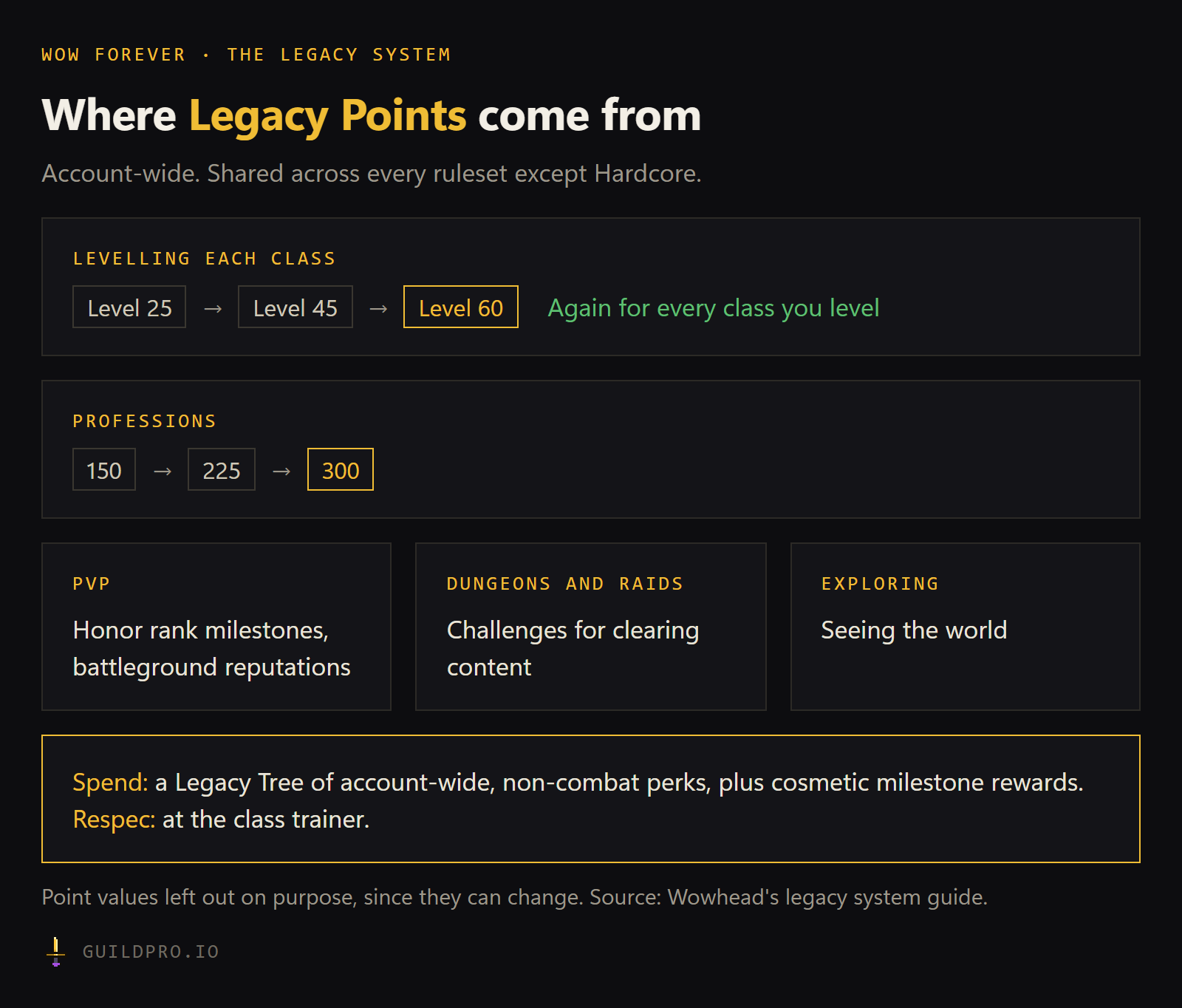
| Challenge | Milestones | What a guild should notice |
|---|---|---|
| Levelling a class | 25, 45 and 60, for each class | Every alt counts |
| Professions | 150, 225 and 300 | Alts can cover the guild’s professions |
| PvP | Honor rank milestones, battleground reputations | Rewards PvP nights |
| Dungeons and raids | See Wowhead’s guide | Rewards turning up |
| Exploring | See Wowhead’s guide | Rewards wandering |
The honor rank system runs to Rank 14, and rank milestones give Legacy Points. Collections and Legacy Points are shared across all rulesets except Hardcore, per Wowhead’s write-up of the no-realms announcement. So an alt on another ruleset still earns points for your account, even though it can’t join your guild.
Why does the legacy system reward alts?
Because levelling a class is a challenge, and there’s one per class. Your first character earns the 25, 45 and 60 steps once. Your second class earns them again. A player who levels five classes earns five sets.
That changes how members play. In Classic, an alt was something you levelled for fun or for a profession, and an officer might quietly wish you’d focus on your main. In Forever, the game itself pays you for the alt. Expect most active members to level more than one character, and expect some to level many.
It also suits the calendar. Raids open on 9 December, and the first one, Barrow Deeps, is 10-player. Blizzard’s roadmap has more raids coming on a roughly 4-month patch cadence, per Wowhead’s report on the patch cadence. That leaves weeks between content where members want something to do. Legacy challenges are that something.
Do alts on another ruleset or faction matter to the guild?
They matter to the player’s Legacy Points, not to your guild’s roster. A guild is one ruleset and one faction, so an alt on another ruleset, or on the other side, can’t group with you, join your guild or fill a raid seat.
That’s worth saying out loud, because the legacy system makes those alts more tempting. A member might level a Horde alt on Normal for the legacy steps while your guild is Alliance on PvP. That’s fine. It just isn’t a guild alt. On the PvP ruleset an account is one faction only, so there the question only comes up across rulesets.
When you ask members which alts they could bring, ask specifically for alts on your ruleset and faction. It saves a disappointed healer in December who levelled the right class in the wrong place.
What does the respec at the class trainer mean?
You can change how your Legacy Points are spent by visiting your class trainer, so an early choice in the Legacy Tree isn’t permanent. The respec cost at launch isn’t something we can confirm, so check in game before planning around it.
For a guild this mostly removes worry. Nobody needs a guide to their Legacy Tree before they start, and an officer doesn’t need to advise on it. Members can spend early, see what helps, and change later.
What does the legacy system mean for a guild’s alt policy?
Write your policy assuming members will have alts, and decide when alts can raid, not whether they exist. Fighting the legacy system is fighting the game.
A few lines that fit Forever:
- Mains raid first. An alt takes a seat only when no main of that role is waiting.
- Alts are welcome on the 10-player raid. It’s the easiest place to fill gaps.
- Loot goes main first. An alt gets an item when no main needs it.
- Ask for alts by role. A healing alt is worth more to the guild than a fourth damage alt.
- Count professions across alts. The profession steps reward alts that gather or craft, so use them to cover the guild’s gaps.
Our main and alt policy post has a full policy you can copy, and our guild professions guide shows how to spread professions across mains and alts.
How do you run a guild alt night?
Pick one night a week, put people in groups by level, and aim each group at a legacy step: the next 25, 45 or 60, or a dungeon in range. Tick these off as you set it up. Your ticks save in this browser, and the button copies the list for Discord.
- Pick one alt night a week that isn’t a raid night
- Ask who is levelling which alt, and at what level
- Group alts within a few levels of each other
- Give each group a target: the next 25, 45 or 60 step
- Pick a dungeon in range for each group
- Put a profession goal on the night too (150, 225 or 300)
- Share Blueprints and crafting materials between alts
- Post who hit a legacy step in Discord the next day
- Ask each month which alts could fill a raid role
Alt nights also solve a quieter problem. Raiders who hit 60 early get bored waiting for the others. An alt night gives them a reason to log in that isn’t pushing the slow levellers.
GuildPro links every character to the person who plays it. Once members sign in and sync, the Members & alts page shows one row per person with all their characters beside them, and attendance and loot count per person, not per character. Manage members and alts explains how alts link themselves, and /raiders shows the public side.
For everything else to set up in your first weeks, open the WoW Forever guild checklist.
FAQ
What is the legacy system in WoW Forever?
An account-wide progression system. You earn Legacy Points from challenges, such as levelling each class to 25, 45 and 60, raising professions, PvP ranks, dungeons, raids and exploring, and spend them in a Legacy Tree on account-wide non-combat perks.
Are Legacy Points shared between rulesets?
Yes, except Hardcore. Collections and Legacy Points are shared across all rulesets except Hardcore, which is a closed ecosystem.
Can I respec my Legacy Tree?
Yes. Per Wowhead's legacy guide, you can respec at the class trainer.
Does the legacy system make alts worth levelling?
Yes. Levelling a class to 25, 45 and 60 is a legacy challenge, so every class you level earns points for your whole account. Plan for members having alts in your main and alt policy.