Raid loot rules template: council, points and rolls
A raid loot rules template to paste into Discord: versions for loot council, points and rolls, plus rules for Forever tier tokens and the 10, 20 and 40 raids.
In this post
- What should raid loot rules cover?
- Which loot rules can I copy?
- How should loot rules handle Forever tier tokens?
- How do the 10, 20 and 40-player raids change the rules?
- How do you handle loot disputes without drama?
- When should you change your loot rules?
- What should you check before you post the loot rules?
Good raid loot rules fit on one screen: the system, who is eligible, how mains, alts and off-specs rank, how tier tokens are handled, and how disputes end. Pick the tab for your system below, copy it, fill the brackets, and pin it before the first raid. For Forever, add the tier token block: tokens start a quest chain with group steps, and Tier 1 is split across the 10, 20 and 40-player raids.
Loot is the one rule every raider reads closely. Forever’s first raids open on 9 December, per Wowhead’s raid overview, which gives your guild about three weeks to write the rules while nobody has a stake in them yet. Rules written before the first drop hold. Rules written after an argument look like they were written for one person.
What should raid loot rules cover?
Six things: the system, eligibility, priority between mains, alts and off-specs, tier tokens, disputes, and the record. Anything longer belongs in a linked document.
| Section | The question it settles |
|---|---|
| System | Council, points or rolls, and who runs it on the night |
| Eligibility | Who can receive loot: trials, bench, alts, people who arrived late |
| Priority | Main spec before off-spec, mains before alts, and how ties break |
| Tier tokens | Who gets a token, and how the guild helps with the quest chain |
| Disputes | Who to ask, when, and what is final on the night |
| The record | Where anyone can see who received what |
If you haven’t chosen a system yet, start with loot council vs DKP, which compares council, points, EPGP, soft reserve and rolls. Then come back for the rules.
Which loot rules can I copy?
Pick the tab for your system. Each block is a complete rules post for Discord, with brackets where your details go. Every block has the same sections, so changing system later means swapping one tab for another.
Loot council
For a small core of raiders who trust the officers. Decisions are fast and can weigh attendance, upgrades and the whole roster.
**[Guild name] · loot rules (loot council)**
Applies to: Barrow Deeps, Hyjal Summit, Onyxia's Lair

**Who decides**
1. The council is [3 names or ranks]. Two of three must agree. Nobody votes on an item they want.
2. The raid leader or master looter announces each item and asks for interest in raid chat.

**How to ask**
3. Type 1 for main spec, 2 for off-spec, 3 for an alt or transmog. Say what it replaces if asked.
4. Interest closes after [30 seconds].

**What the council weighs, in order**
5. Main spec upgrade size, attendance over the last [4 weeks], items already received this tier, and the raid's needs (tanks and healers first when the raid is short of them).
6. Trials are eligible after [2 raids] at [half / normal] priority.
7. Bench raiders keep their priority. Being benched is helping the raid.

**Tier tokens**
8. See the tier token rules below.

**Disputes**
9. Decisions are final on the night. Questions go to [officer channel or name] within [48 hours], and we answer in private.
10. The council posts a one-line reason for any contested item in #loot-log.

Loot history: [link]. Rules can change between tiers, never mid-raid.
Points (DKP-style)
For a large roster that wants every decision visible. Points are earned by turning up and spent on items.
**[Guild name] · loot rules (points)**
Applies to: Barrow Deeps, Hyjal Summit, Onyxia's Lair

**Earning points**
1. [10] points for being in the raid at the pull. [10] more at the end. [5] for each boss killed.
2. Bench raiders on standby earn the same as the raid.
3. Points are kept in [spreadsheet or tool link], updated within [24 hours] of each raid.

**Spending points**
4. Items are [closed bid / fixed cost: (cost table link)]. Highest bid wins. Ties are settled by /roll.
5. Main spec bids beat off-spec bids, whatever the amount. Alts can only bid if no main bids.
6. Minimum bid: [10]. You can't bid more than you have.

**Decay and new members**
7. Everyone's points drop by [10%] each [week / month] so long-held points don't block new raiders.
8. Trials start at [0 / half the raid average] points.

**Tier tokens**
9. See the tier token rules below.

**Disputes**
10. Point mistakes go to [officer name] within [48 hours] with the raid date. Item results stand on the night.

Points table: [link]. Loot history: [link].
Loot rolls
For a casual, social or pug-friendly raid. Simple and fast, with a few rules to keep rolls fair.
**[Guild name] · loot rules (rolls)**
Applies to: Barrow Deeps, Hyjal Summit, Onyxia's Lair

**How to roll**
1. /roll 100 for main spec. /roll 99 for off-spec. /roll 98 for an alt or transmog.
2. Main spec rolls beat off-spec rolls whatever the number.
3. Only the first roll counts. Rolling the wrong number means you pass.

**Limits**
4. [One / two] main spec items per raid until everyone who wants one has had one.
5. [Optional] Soft reserve: each raider reserves [1] item before the raid at [link]. Reserved items are rolled only among people who reserved them.

**Tier tokens**
6. See the tier token rules below.

**Disputes**
7. The raid leader's call on the night is final. Questions go to [name] afterwards.

Loot history: [link].
Leave out any rule you won’t enforce. A loot rule that officers bend for a friend teaches the raid that every rule bends.
How should loot rules handle Forever tier tokens?
Treat a token as the start of a job, not the end of one: the raider still has a quest chain to finish, and some steps need a group. A tier token unlocks a quest chain that ends in the tier piece, and some steps need group content, per Wowhead’s report on tier pieces. Blizzard hasn’t said yet which steps those are, so don’t promise more than that.
Three things follow for your rules:
- A token that sits unfinished is a wasted drop. Say how long a raider has to start the chain before the officers can ask why.
- The guild should help with the group steps. Put them in the weekly plan the same way you would a dungeon night.
- Decide what happens to a token nobody can use. Disenchant, pass to an alt, or give to the next main spec bidder.
**Tier tokens**
1. Tokens go to mains first, by our normal [council / points / roll] rules.
2. Tokens count as [one main spec item / a full-cost item] for limits and priority.
3. Start the quest chain within [1 week]. The steps that need a group go in #raid-prep, and we'll fill groups on [day].
4. If nobody's main can use a token, it goes to [an alt by roll / the next bidder / the guild bank].
5. A raider who leaves the guild keeps what they've received. Unfinished chains are their own to finish.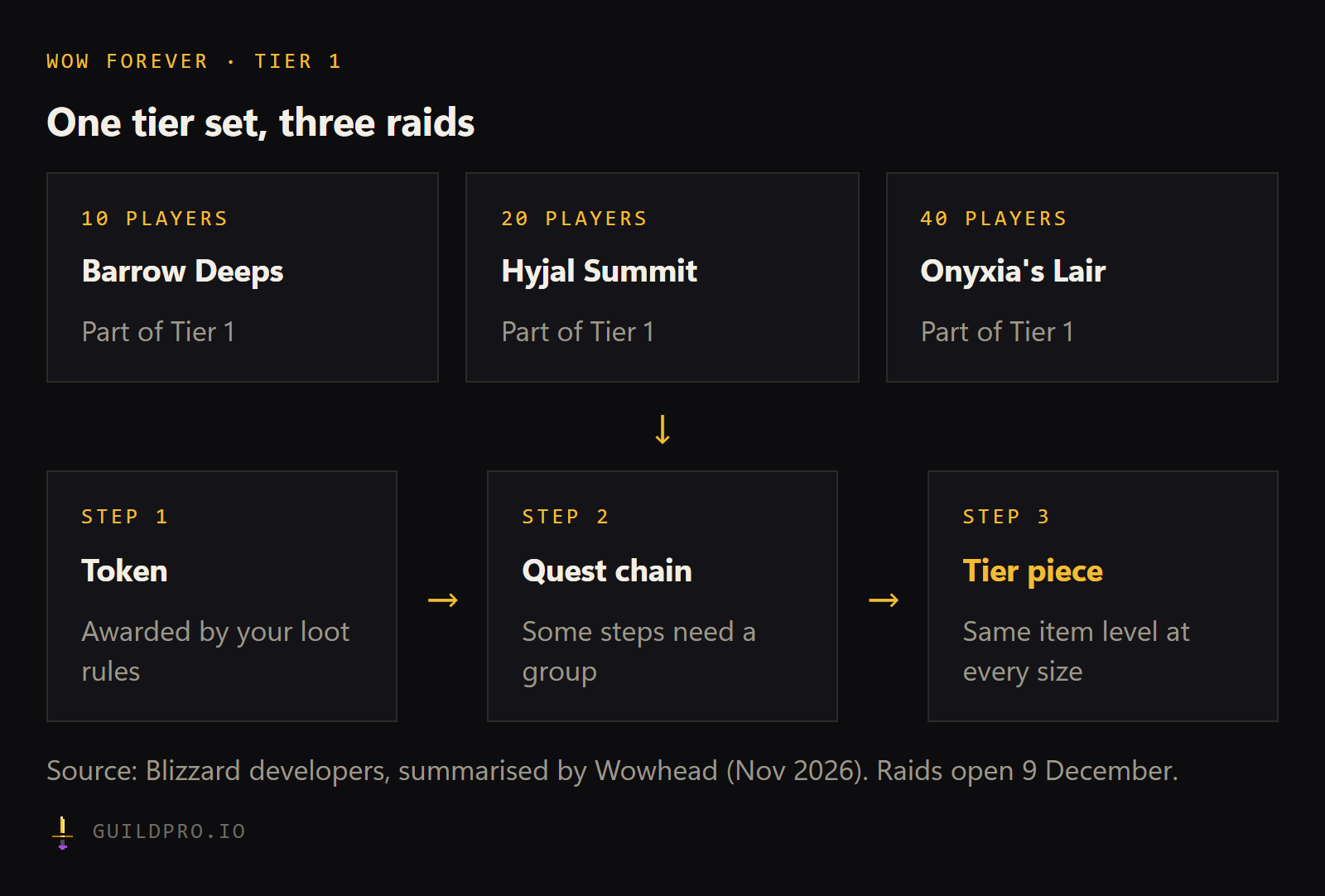
How do the 10, 20 and 40-player raids change the rules?
Write one set of rules that covers all three raids, and say how they count together. Tier 1 is split across Barrow Deeps (10), Hyjal Summit (20) and Onyxia’s Lair (40). Item level is the same at every size, and a guild that only runs the 10-player raid gets “a lot, just not everything”, per Blizzard developers in Wowhead’s interview summary.
That matters for loot rules in a few ways:
- One priority across all three. If you use points, one pool for every raid keeps a 10-player regular from out-bidding a 40-player regular on the night they meet.
- Several 10-player groups. A guild may run two or three Barrow Deeps groups. Say whether a raider can take loot in only one group a week, or in any group they join.
- Onyxia drops a lot. Blizzard’s developers expect plenty of loot from it, so a per-raid limit on main spec items stops one lucky night from deciding the tier.
- Hyjal has wings. You can target bosses later, so a raider who missed a drop can come back for it. Rules don’t need to rush it.
How you staff all three is its own question, covered in Forever raid sizes.
How do you handle loot disputes without drama?
Decide in advance that the night’s result stands, and give every question a private place to go afterwards. Most loot drama starts in raid chat, in front of 20 people, during a wipe. Move it.
- Final on the night. Nobody re-rolls or re-awards an item after the raid moves on. Mistakes are fixed next time, by priority, not by taking an item back.
- A 48-hour window. Questions after that are about next tier.
- A written reason. For loot council, one line in the officer channel (“date, item, who, why”) ends most arguments before they start.
- The record is public to members. If anyone can see who has had what, nobody can claim the council favours a friend without checking first.
GuildPro doesn’t hand out loot. The addon records what dropped and who received it,
and the guild’s Loot page lists items per raider and every drop, newest first, for
any loot system. /loot posts recent epic drops in Discord. See
loot history.
When should you change your loot rules?
Between tiers, never in the middle of one, and always with a post that says what changed. The next natural point after 9 December is the next patch. Blizzard is aiming for about one major patch every 4 months, per Wowhead’s patch cadence report.
Before you change anything, ask the raid. A short survey on the loot system takes the heat out of the decision, and the result is something officers can point to.
What should you check before you post the loot rules?
Run through this list, then post the rules in a read-only channel and link them from your guild rules. Ticks are saved in your browser, and Copy for Discord turns the list into a message for your officers.
- The system named in the first line
- Who runs loot on the night, and who can overrule
- Trials, bench and alts: eligible or not, and at what priority
- Main spec before off-spec, written out
- Tier token rules, including tokens nobody can use
- How the 10, 20 and 40-player raids count together
- A per-raid limit, if Onyxia nights worry you
- Final on the night, with a 48-hour window for questions
- A link to where the loot record lives
- The date the rules take effect
Loot rules sit inside your wider guild rules, so start from the guild rules template, and the rest of the launch list is in the WoW Forever guild checklist. When raids start, signups and rosters show who is coming before the night.
FAQ
What should raid loot rules include?
Which system you use, who is eligible, how mains and alts rank, what happens to tier tokens and off-spec items, how disputes are handled, and where the record of who got what lives. One screen is enough.
Which loot system is best for a new WoW Forever guild?
There isn't one best system. Loot council suits a small, trusting core, points suit a large roster that wants everything visible, and rolls suit casual and pug groups. Our loot council vs DKP post compares them.
How do tier tokens work in WoW Forever?
A tier token starts a quest chain that ends in a tier piece, and some steps need group content, per Blizzard developers summarised on Wowhead. Tier 1 is split across Barrow Deeps, Hyjal Summit and Onyxia's Lair, so loot rules should say who gets tokens and who gets help with the chain.
Should loot rules be different for the 10, 20 and 40-player raids?
The system can stay the same, but say how the three raids count together. Tier 1 is spread across all three, and Blizzard says item level is the same at every size, so a raider who skips one raid misses part of the set.
Does GuildPro run loot council or DKP?
No. GuildPro records what dropped and who received it, from the addon, so you can check history against your rules. It has no council, points or priority tools. See loot history.