WoW guild trial period: rules, check-in and a kind no
How to run a WoW guild trial period: trial rules to copy, what officers should watch, the 2-week check-in, and how to say no kindly when a trial doesn't work.
In this post
A WoW guild trial period works when both sides know the rules before it starts: how long it lasts, what you’re watching, and when you’ll decide. Two weeks is a common length. Hold a short check-in at the end, decide pass, extend once or part ways, and give a no privately with one honest reason.
Most guild trials fail quietly. Someone joins with a “trial” rank, nobody tells them what that means, and three weeks later they either drift away or get promoted because nobody wanted the conversation. A trial with written rules and a date on it fixes both. This page gives you the rules, what to watch, the check-in, and the message for when the answer is no.
What is a guild trial period for?
It lets the guild and the new member find out whether they fit before either side has committed. It isn’t an exam. A good trial is as much for the recruit as for the officers.
An application tells you what someone says about themselves. A trial shows you how they play with your people on your nights. The recruit learns the same about you: how the raid leader talks after a wipe, whether loot rules are followed, whether the guild does what its recruitment post said.
How long should a WoW guild trial last?
Two weeks, or a set number of raid nights such as 4. Long enough to see someone on a good night and a bad one. Short enough that nobody feels stuck on a trial rank.
In Forever there’s a wrinkle. The first raids open on 9 December, per Wowhead’s raids overview, so a trial that starts in November has no raids to judge. Run it on what you do have: dungeon nights and levelling groups. The nine new dungeons are a fair test of the things that matter, such as turning up on time, knowing your class and staying calm when a pull goes wrong. Say so in the rules, so the recruit knows what counts.
What should a guild’s trial rules say?
How long the trial is, what it gives the recruit, what you’re looking at, and how it ends. Pin it in Discord and send it to every new trial on their first day. Copy this, fill in the brackets and cut what doesn’t apply.
**Trial period · how it works**

**Length:** [2 weeks / 4 raid nights]. Your check-in is on [date].
**Rank:** Trial. You get [raid signups, guild bank tab 1, voice].
**Before raids open (9 December):** we judge dungeon nights and levelling groups instead.

**What we look at**
- Showing up when you signed up, and giving notice when you can't
- Coming prepared: [consumables, repairs, addons, knowing the fights]
- Taking feedback, and giving it calmly
- How you treat other people, in game and in Discord

**What we don't look at**
- One bad night
- Gear you haven't had the chance to get yet

**Loot during trial:** [same rules as members / members first on contested items]

**How it ends**
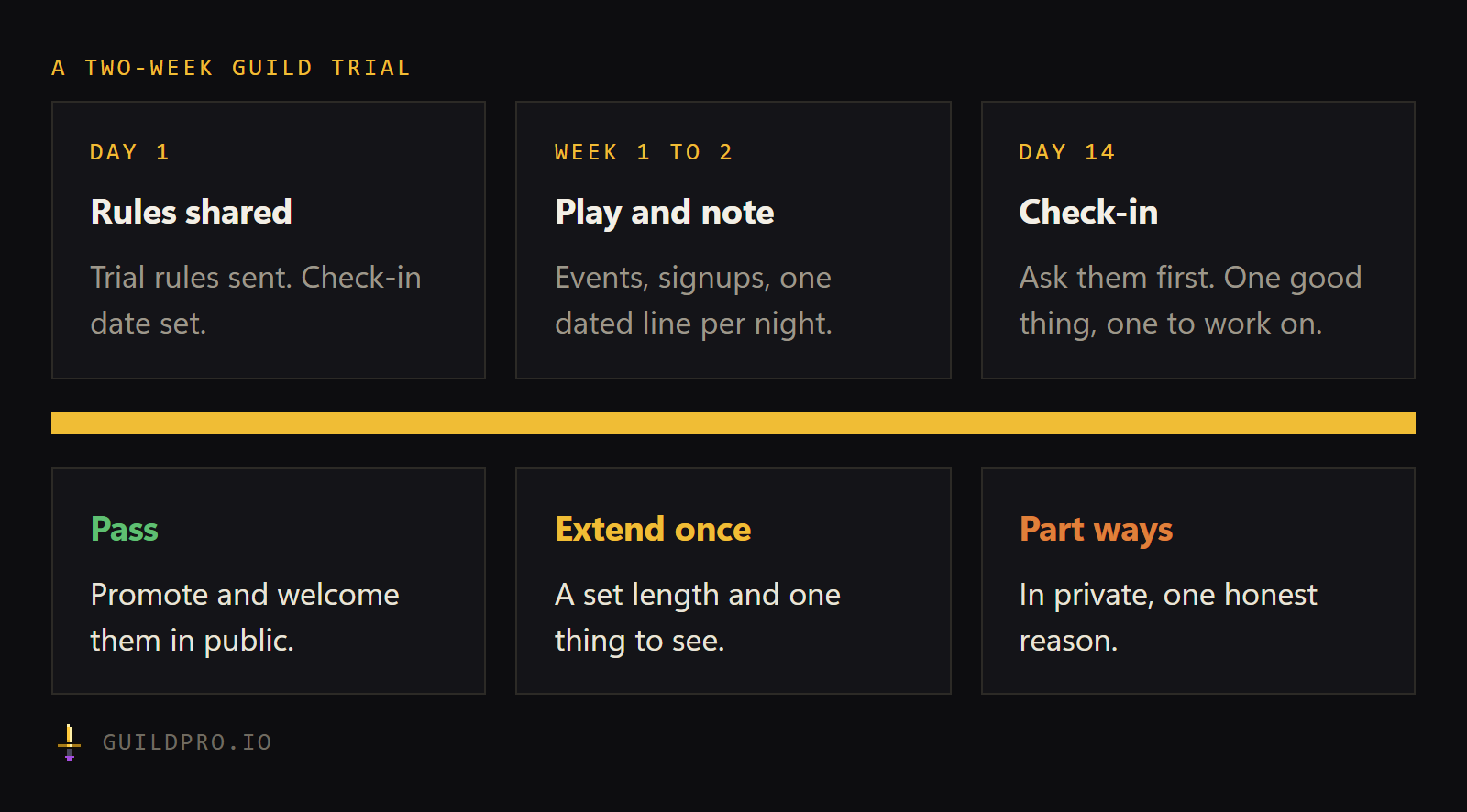
At the check-in we decide one of three things: you pass, we extend once by [1 week], or we part ways. You'll hear it from [officer name] in private, with a reason.

Questions any time: [officer name].
Two lines matter most. What we don’t look at stops trials from trying too hard on one night. Loot during trial heads off the argument most trial guilds have in week 2. Our loot council vs DKP post covers the common rules.
What should officers watch during a trial?
Reliability, preparation and how the recruit treats people. Performance matters, but it’s the easiest thing to fix and the least reliable to judge from a few nights.
| Watch | What it looks like | Why it matters |
|---|---|---|
| Showing up | Signed up and came, or gave notice | The raid is built around who said yes |
| Preparation | Repaired, consumables, knew the plan | Shows they read the Discord |
| Feedback | Asked questions, adjusted next pull | Tells you how the next tier goes |
| Behaviour | How they talk after a wipe, in chat, in DMs | One person can change a raid’s mood |
| Loot | Followed the rules, even when they lost | The first sign of future drama |
Keep notes in one place every officer can see, with a date and one line per event. “Late, no notice” on Tuesday is useful. “Seems a bit off” isn’t. If a trial is new to their class, point them at Wowhead’s Forever class guides early, rather than marking them down for it at the check-in.
On GuildPro, trials are a stage on the application. Tick Run trials on the Your listing card of the guild’s Recruitment page, and a Start trial button and an On trial group appear on the Applications card. The recruit’s status page shows Trial, so they always know where they stand. When you decide, Accept adds them as a raider and Decline… asks for a reason that’s shown on their status page. Once raids are recorded, the guild’s Attendance page shows each person’s raids, excused absences and no-shows. Applications and trials.
What happens at the 2-week check-in?
A short private conversation that ends with a decision: pass, extend once, or part ways. Ten minutes in voice or a few messages is enough. Book it on day 1 so it isn’t a surprise.
- Ask them first. “How have the two weeks felt?” Their answer often tells you whether they’re staying before you say anything.
- Give one or two observations. One thing that went well, one thing to work on. Use your notes, with dates.
- Decide, and say it. Don’t end with “we’ll see”. If you need more time, extend once, for a set length, with the one thing you need to see.
Before the check-in, tick these off as officers. Your progress saves in this browser, and the button copies the list for your officer channel.
- Trial rules were sent on day 1
- Check-in date was set on day 1
- Notes cover every event they signed up for
- At least 2 officers have seen them play
- Attendance and notice checked against signups
- One thing that went well, written down
- One thing to work on, written down
- A decision agreed by officers before the call
- The officer giving the news is the one they know best
- Rank updated straight after the call
How do I say no to a trial kindly?
Privately, briefly, with one honest reason and a thank you. The person who didn’t pass will tell their friends how it went. A short, respectful message keeps your reputation better than a long list of faults.
- Do it yourself. A rank change with no message is the worst way to find out.
- One reason, not five. Pick the one that decided it.
- No debate. Explain once. If they push back, thank them again and leave it.
- Leave the door open only if it’s true. “Apply again after the next tier” is kind when you mean it and cruel when you don’t.
Hi [name], thanks for the last two weeks with us.

We've talked it over as officers and decided not to move you to full member. The main reason is [one honest reason, e.g. our raid nights and your availability haven't lined up / we need more notice when plans change than we've had].

That's about fit, not about you as a player, and we appreciate the [dungeon nights / effort / good humour] you brought.

[If true: If things change, you're welcome to apply again after [date or tier].]

You can stay on our Discord as a friend of the guild if you'd like. Good luck in Forever.
[Officer name]
And when the answer is yes, say that clearly too. A short public welcome in Discord on the day someone passes is the cheapest retention tool a guild has.
For the questions to ask before anyone reaches a trial, see our guild application template. For everything else a Forever guild should have in place, work through the WoW Forever guild checklist.
FAQ
How long should a WoW guild trial period be?
Two weeks is a common length, or a set number of raid nights, such as 4. Long enough to see someone on a good night and a bad one, short enough that nobody feels strung along.
What should officers watch during a guild trial?
Whether the trial shows up when they said they would, gives notice when they can't, comes prepared, takes feedback well and treats people decently. Those matter more than one night's performance.
Can a trial run before WoW Forever's raids open?
Yes. Raids open on 9 December, so a trial before then can run on dungeon nights and levelling groups. Tell the trial that, and judge the same things: showing up, preparation and how they play with others.
How do I tell someone they didn't pass their trial?
Privately, briefly and with one honest reason. Thank them, say it isn't the right fit, give the reason without a list of faults, and leave the door open if that's true. Our template is on this page.